

Artist Statement
This artist statement reflects the ideas, experiences, and creative process behind the paintings of Swedish artist Andy Renard.
This artist statement is not only about finished paintings, but also about process, observation, memory, and the experiences that shape the work over time. It offers a closer look into the thoughts and themes behind the artistic practice of Andy Renard.
Introduction
Between Inner and Outer Worlds
My paintings move between inner and outer worlds — between memory, imagination, observation, and human experience. I do not paint objects simply for their appearance. Every figure, landscape, symbol, or gesture carries an emotion, tension, story, or unanswered question beneath the surface.
Recurring themes constantly return throughout my work in different forms: beauty and decay, humor and darkness, nature and humanity, silence and chaos. Through symbolic, figurative, and sometimes dreamlike imagery, I explore the psychological and emotional layers hidden within both the world around us and the worlds we carry inside ourselves.
Themes and Symbolism
Human Presence
Human presence exists at the center of almost all my work. Sometimes the human figure appears directly within the painting, and sometimes the viewer becomes the human presence inside the image itself. I see humanity as inseparable from nature, memory, contradiction, vulnerability, desire, fear, humor, and constant transformation.
Nature and Emotional Landscape
Nature is not simply a backdrop in my paintings, but a living force. It can contain peace, violence, harmony, mystery, silence, or emotional chaos all at once. I am drawn to the way nature reflects parts of ourselves that modern life often distances us from — instinct, fragility, imagination, and emotional truth.
Symbolism and Interpretation
Many of my paintings contain symbolic or dreamlike elements, though I rarely approach symbolism as a fixed language with absolute meanings. Some images carry clear emotional or psychological weight, while others exist more intuitively. Sometimes a dark shape is simply a dark shape.
I am interested in the tension between meaning and mystery, between conscious intention and the unexpected things that emerge naturally during the act of painting.
Identity, Absurdity, and Contradiction
Recurring themes in my work include identity, absurdity, memory, mortality, and human contradiction. Identity especially fascinates me because it is never stable. People move through different versions of themselves throughout life, often carrying hidden layers beneath the identities they present to the world.
Humor and darkness coexist naturally in my paintings because they coexist naturally in life itself. Without humor, darkness becomes unbearable. Without darkness, humor loses its depth. I often use irony, satire, or subtle absurdity to approach difficult subjects without becoming overly rigid or ideological.
The Human Body
The human body — often female, partially clothed, or nude — also appears frequently in my work. Not primarily as erotic imagery, but as something vulnerable, symbolic, innocent, emotional, and deeply human. The body can simultaneously express beauty, fragility, intimacy, memory, and transformation.
Society and Human Behavior
While some works contain social or political undertones, I rarely approach criticism in a direct or aggressive way. I am more interested in poetic or darkly humorous reflections on the strange realities of modern life and human behavior.
Process and Technique

Materials and Artistic Freedom
Although I work primarily with oil and acrylic painting, I do not see myself as limited to a single material or discipline. Acrylic painting became an important gateway into painting because of its immediacy and flexibility, while oil painting gradually became the medium I feel most deeply connected to.
At the same time, I remain open to experimentation through photography, digital work, sculpture, and other forms of visual expression whenever the idea itself calls for it.
Layers and Transformation
My paintings often develop through layers — both physically and psychologically. Some works begin with sketches and carefully developed ideas, while others emerge more instinctively through spontaneous marks, movement, and texture placed directly onto the canvas.
I rarely aim for photo-realistic perfection. Instead, I am more interested in atmosphere, emotion, tension, movement, and the visible presence of the human hand within the work.
Texture and Brushwork
Texture and brushwork play an important role in this process. I appreciate surfaces where paint remains alive and visible rather than polished into photographic illusion.
Small imperfections, rough edges, and visible brushstrokes are not mistakes to remove, but traces of time, instinct, emotion, and physical presence. They remind both myself and the viewer that a painting is a living object created through uncertainty, intuition, and human involvement.
Movement and Emotional Motion
Movement is equally important to me. Even within still images, I search for rhythm, tension, and emotional motion. This creates freedom beyond realism alone, allowing distortion, symbolism, abstraction, and imagination to coexist naturally within the same work.
Ideas and Intuition
Ideas for paintings can appear unexpectedly — through conversations, memories, music, silence, dreams, nature, or fleeting moments from everyday life. I often sketch fragments of these ideas quickly before they disappear.
However, once the painting process begins, the work frequently develops far beyond the original concept. I try to remain open to that transformation rather than forcing complete control over the final image.
Time and Evolution
Many of my paintings also evolve over long periods of time. A large portion of a work may emerge during a single intense session, yet the painting can continue changing for weeks or months afterward.
Entire figures, faces, or compositions may disappear and reappear during the process. For me, a painting is rarely finished quickly — it slowly reveals itself over time.
Emotional Experience

Stories Without Conclusions
My paintings are not created to provide fixed answers or singular interpretations. Each work contains a story, emotion, atmosphere, or underlying tension, but rarely a conclusion.
I often think of a painting as existing somewhere in the middle of a larger narrative — within the uncertainty, movement, and emotional weight of the story rather than at its ending.
Space for Interpretation
I prefer to leave space for imagination and personal interpretation. Different viewers are naturally drawn toward different details within the same image: light, atmosphere, movement, symbolism, humor, figures, or small absurd elements hidden within the composition.
That openness matters to me because human experience itself is never completely fixed or objective.
Darkness, Warmth, and Humanity
Although darkness often exists within my work, I rarely want it to become hopeless or purely destructive. Humor, irony, warmth, tenderness, and vulnerability are equally important because they create balance within both art and life.
Even in paintings that contain loneliness, melancholy, fear, or tension, I hope there remains some trace of humanity beneath the surface.
Between Dream and Reality
Many of my works exist somewhere between dream and reality. Some may feel mysterious, nostalgic, symbolic, unsettling, or emotionally ambiguous, while others move closer toward satire, surrealism, or quiet contemplation.
I am less interested in creating purely decorative images than in creating images that remain emotionally alive — works that invite the viewer to pause, reflect, question, or imagine something beyond the immediately visible.
Instinct and Emotional Tension
At the same time, I do not begin with the intention of controlling emotional reactions. The paintings emerge first from instinct, curiosity, imagination, and personal necessity.
Only later, during the process itself, do I sometimes shape certain elements in ways that create stronger tension, rhythm, curiosity, or emotional focus.
Contradiction and Human Emotion
Contradictory emotions often coexist within the same painting because they coexist within human life itself. Beauty can exist beside decay, intimacy beside isolation, warmth beside darkness, and humor beside sorrow.
Some of the most human experiences emerge precisely within those tensions.
Closing Reflection
Painting as Identity
Painting has gradually become far more than a creative activity for me — it has become part of my identity and one of the most honest ways I can process thoughts, emotions, memories, questions, and imagination.
Creativity has always existed throughout my life in different forms, including music, photography, writing, and digital art, but painting feels fundamentally different because of its physical and human presence.
Beyond the Screen
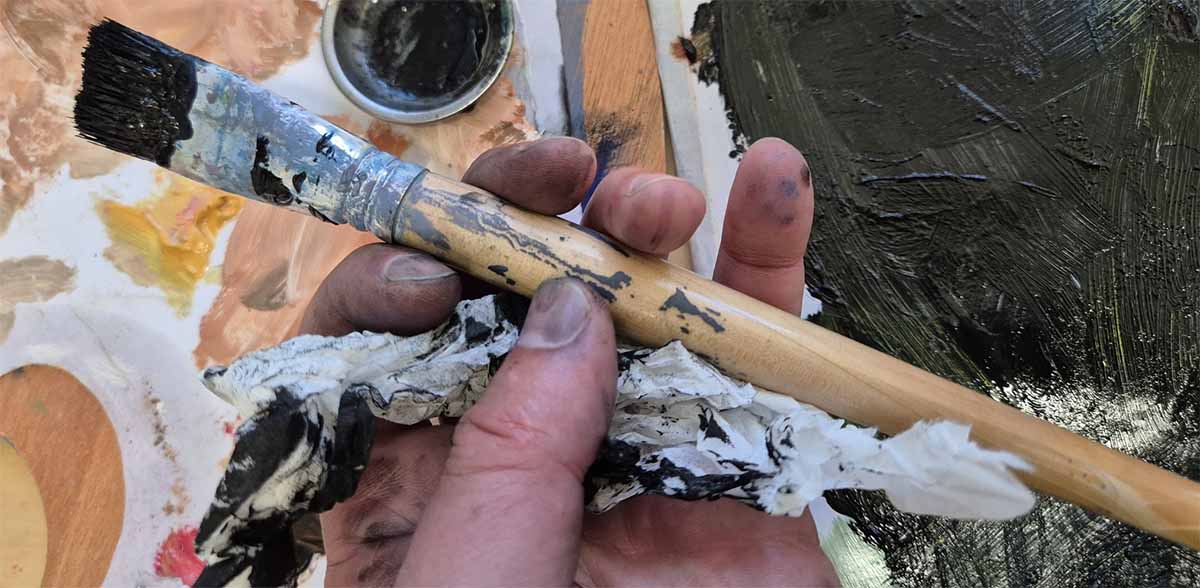
Unlike screen-based creative work, painting brings me back into direct contact with material, movement, instinct, silence, and time. There is something deeply human about standing in front of a canvas and allowing an image to slowly emerge through uncertainty, intuition, and observation.
Why Images Still Matter
I believe images still matter profoundly in the modern world. We are surrounded by endless streams of temporary digital content, yet a painting possesses a different kind of presence and emotional weight.
A painted image can hold memory, contradiction, beauty, tension, humor, symbolism, and mystery simultaneously in ways that often cannot be fully reduced to words.
Fragments of Life and Imagination
Many of my ideas begin as fleeting impressions — fragments of conversations, atmospheres, dreams, memories, observations, or emotions that gradually evolve into something larger through painting.
These fragments become worlds that are both personal and open-ended.
The Viewer as Part of the Story
I rarely want to provide final answers through my work. The paintings are not conclusions or fixed statements. They exist somewhere within the middle of the story rather than at its ending.
Because of that, the viewer also becomes part of the image through interpretation, imagination, emotion, and personal experience. Different people will always discover different meanings within the same painting, and I see that openness as an essential part of what makes art remain alive.
Andy Renard
Latest news from the Journal
- From Our First Date to an Oil Painting – A Portrait of My Wife
- The Three Sunflowers – I Was Only Supposed to Paint Sunflowers!
- Växjö Konstrunda – Local Artists, Art & Inspiration in Småland
- My Art Is Now on Saatchi Art
- 人 — The Character I Never Forgot
Exploring the Artistic World of Andy Renard
Through figurative painting, symbolism, and narrative imagery, Andy Renard explores themes of memory, identity, human relationships, and the tension between reality and imagination. This website presents original paintings, fine art prints, and reflections on the creative process behind the work.