
There are political paintings that try to explain the world with precision.
And then there are paintings that simply hold up a distorted mirror and let the viewer laugh, cringe, or recognize something uncomfortable in the reflection.
L’État, c’est moi belongs to the second category.
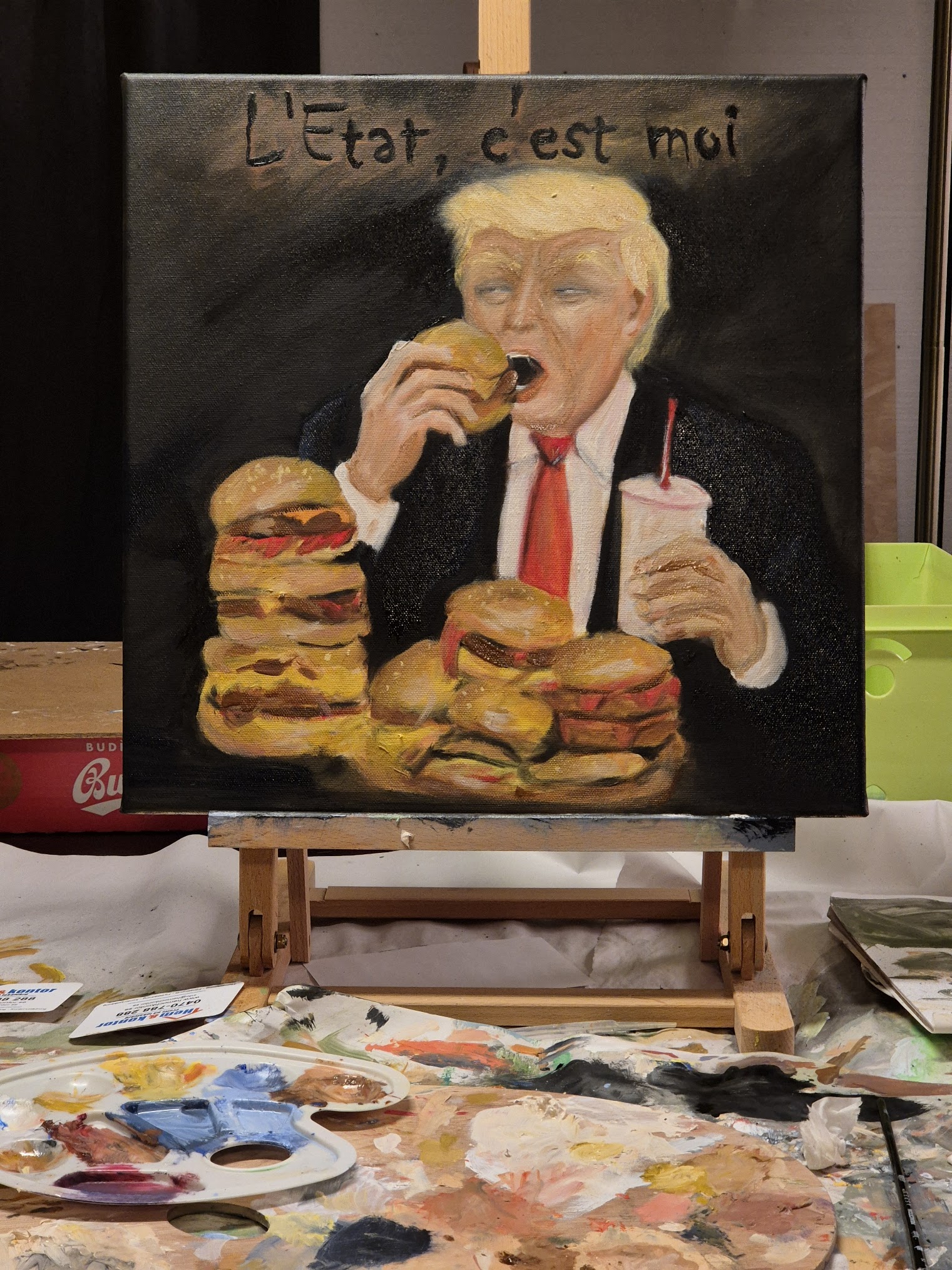
The title borrows the famous phrase traditionally attributed to King Louis XIV of France — “I am the state.” Whether he actually spoke the exact words is debated by historians, but the expression has survived because it perfectly captures the image of absolute power concentrated in a single person. The king was not merely ruling France; he was France. His personality, appetite, ego, and authority merged into one grand spectacle.
Centuries later, Donald Trump became a modern political figure whose public persona often felt built on a similar kind of theatrical gravity. Not in powdered wigs and Versailles silk, of course, but through branding, celebrity culture, dominance, excess, and the constant performance of self. The painting does not try to compare historical systems literally. Instead, it plays with symbolism and visual irony.
A king once sat beneath chandeliers and golden ceilings.
A modern ruler sits beneath fast-food wrappers and television lights.
The throne changes shape.
The spectacle remains.
Why burgers?
The hamburgers are intentionally excessive. They almost become architecture — stacked like monuments around the figure. They are absurd, humorous, and slightly grotesque at the same time.
Fast food has become part of Trump’s public mythology. Unlike carefully staged presidential imagery of polished dining rooms and refined etiquette, Trump often embraced a deliberately commercial and populist aesthetic. Burgers, branded products, giant logos, and oversized portions became visual extensions of the persona itself: unapologetic consumption, instant gratification, and spectacle over subtlety.
In this painting, the burgers are not really about food.
They represent appetite.
- Appetite for attention.
- Appetite for power.
- Appetite for wealth.
- Appetite for dominance.
- Appetite for being seen.
The composition intentionally borders on caricature. The face is exaggerated, the gestures theatrical, the colors warm and greasy against a dark background. It sits somewhere between political satire and expressionism. The goal was never photorealism. The goal was to capture a feeling.
A kind of modern royal portrait painted through the language of mass consumption.
The phrase behind the painting
The phrase L’État, c’est moi has fascinated artists and writers for generations because it symbolizes one of humanity’s oldest temptations: the belief that personal identity and public authority are inseparable.
When leaders begin to see criticism of themselves as criticism of the nation itself, politics transforms into performance. Institutions become secondary to personality. Loyalty becomes emotional rather than rational.
That is part of what interested me while painting this work.
Trump is uniquely suited to this type of visual metaphor because he has always existed simultaneously as politician, celebrity, businessman, television character, and brand. Even people who strongly disagree about his politics often recognize the same thing: he dominates attention.
And attention itself has become a form of power in modern society.
Humor as criticism
The painting is critical, but not in a purely angry way.
I have always believed humor can sometimes reveal more than outrage. Satire allows viewers to approach uncomfortable subjects without immediately becoming defensive. A grotesque burger tower can say something that a thousand political slogans cannot.
The painting exaggerates reality because modern politics already feels exaggerated.
That tension between comedy and discomfort is important to me. I do not want the work to become propaganda for one side or another. I am more interested in the strange theatrical nature of modern leadership, media culture, and public identity.
At first glance, the painting may look playful.
But the longer you look, the darker the undertone becomes.
- The empty eyes.
- The compulsive consumption.
- The isolation behind the spectacle.
- The darkness surrounding the figure.
It becomes less about one politician and more about a culture built around excess and personality worship.
Painting style and process
The work was painted in a loose, expressive manner rather than a tightly controlled realist approach. I wanted visible brush movement and slightly distorted anatomy because perfection would have weakened the emotional tone.
The roughness matters.
Political imagery often becomes stronger when it feels unstable or slightly uncomfortable. Clean realism can sometimes make satire feel too polite. Here, the blurred transitions and exaggerated forms create a sense of overstimulation — almost like watching modern media culture melt together into one endless stream of branding, noise, and consumption.
The dark background also plays an important role. It isolates the figure like a stage spotlight. There is no environment, no White House, no crowd, no context.
Only the man.
The food.
The performance.
Available as print and framed print
L’État, c’est moi is available both as a fine art print and as a framed print through our shop.
The framed version especially works well with the painting’s dramatic contrast and dark tones, giving it a strong presence on the wall while preserving the satirical mood of the original artwork.
Whether viewed as political satire, social commentary, or simply dark humor, the painting is meant to provoke a reaction — ideally somewhere between laughter and reflection.
Sometimes the best way to talk about power is not through speeches or manifestos.
Sometimes it is through a man eating burgers beneath the words:
“I am the state.”