
Over the past few weeks, something rather unexpected has been happening behind the scenes on my website.
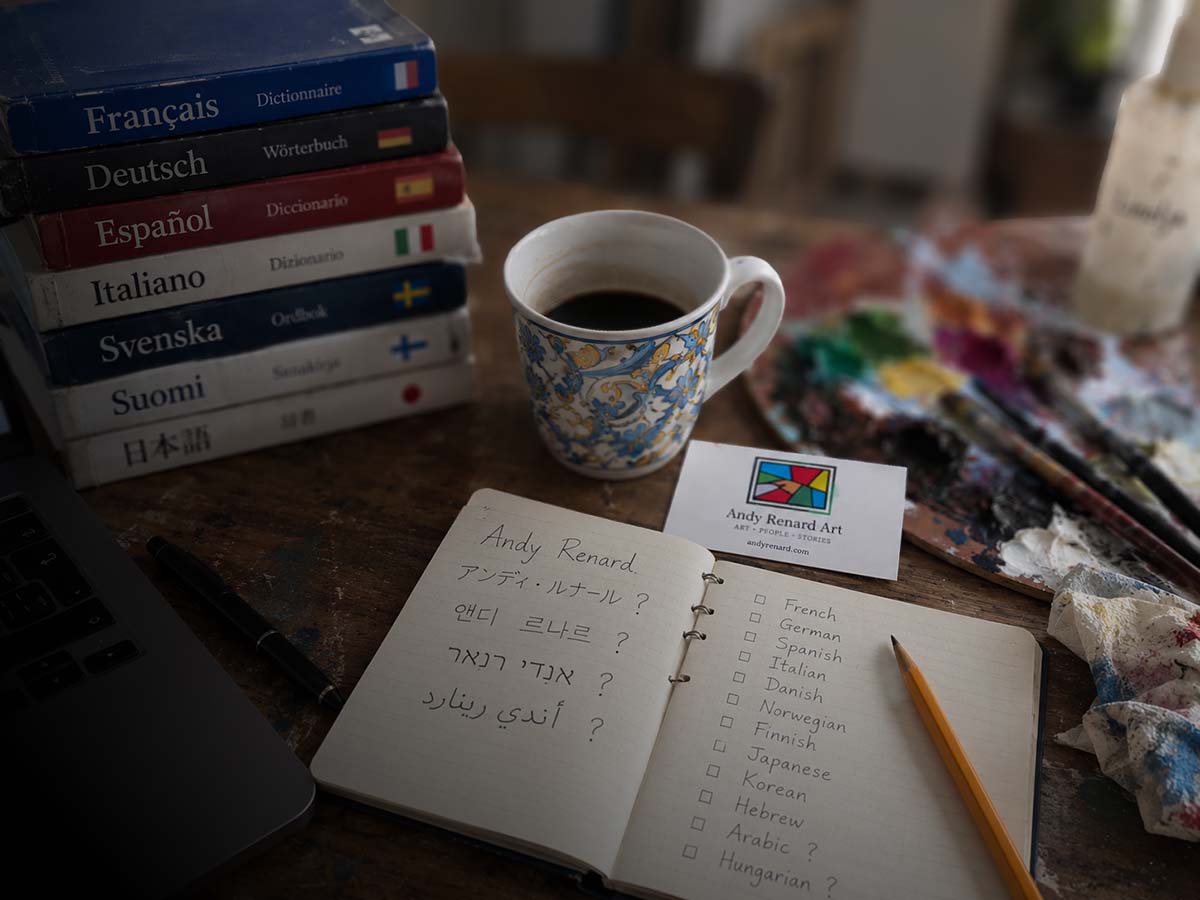
I have been learning languages.
Well — perhaps that is an exaggeration. I have been working with languages. A lot of them.
I have been creating dedicated pages about my art and my work as a Swedish artist in different languages. English has always been the main language of AndyRenard.com, but art does not really belong to one language or one country. People discover paintings from everywhere, and increasingly I have wanted someone searching in Paris, Berlin, Copenhagen, Tokyo or Helsinki to be able to discover my work in their own language.
Today we have extraordinary translation tools available to us. I use them. I see absolutely no reason to pretend otherwise.
But I have also discovered that translating a website properly is very different from pressing a button marked “Translate”.
Translation is surprisingly slow
A translation can look perfectly convincing and still make you suspicious.
Is that really how a French person would describe a contemporary artist?
Does that German expression mean exactly what I think it means?
Did the translator translate the title of a painting that should never have been translated?
Is the word for an original painting actually the word people use when searching for one?
So I find myself moving backwards and forwards between languages, dictionaries, translation tools and search results. I translate something, translate it back, compare alternatives, change a sentence and then discover that changing one word has changed the meaning of another.
It is considerably more work than I expected.
And strangely enough, I enjoy it.
Meeting French again
French was particularly interesting.
I studied French at school a very long time ago, and I would certainly not claim that I can speak French today. But something peculiar happens when I see it written down.
Some of it comes back.
I can look at a paragraph and often understand what it is saying. Perhaps not every individual word, but enough to notice when a translation suddenly feels wrong.
It is almost as though the language has been sleeping somewhere in the back of my head for decades.
That made working on my French artist page surprisingly enjoyable. I still needed help from translation tools, but I was never completely disconnected from the language in front of me.
German gives me a different kind of familiarity. German and Swedish are both Germanic languages, and although they have developed in very different directions, there are moments when structures and words suddenly feel surprisingly close.
While creating the German version of my Swedish artist presentation, I found that familiarity particularly useful. I cannot write a German artist biography unaided. Not remotely.
But I am not completely blind when I read one either.
And that makes an enormous difference when checking a translation.
Danish and Norwegian — our linguistic neighbours
Then there are Danish and Norwegian.
For a Swede, these are not really foreign languages in quite the same way.
They are our linguistic siblings.
Sometimes the similarity is almost comical. A sentence can look completely understandable until one small word suddenly means something slightly different from what a Swedish speaker expects.
Norwegian in particular can feel remarkably close to Swedish on the page. Creating my Norwegian artist page therefore felt less like translating into an entirely foreign language and more like carefully adjusting the way I introduced myself.
Danish is another story when spoken — I shall diplomatically leave that discussion for another day.
But written Danish is often beautifully familiar, and the Danish presentation of my art and paintings still feels recognisably Scandinavian to me.
Working with these languages feels less like travelling to another continent and more like visiting cousins who live on the other side of the border.
And then came Finnish
Finnish was different.
Very different.
Finland is one of Sweden’s closest neighbours. We share centuries of history, geography and culture.
Our languages, however, do not share that closeness.
Finnish belongs to an entirely different language family from Swedish, and suddenly most of the linguistic handrails I had been using disappeared.
With French, German, Norwegian, Danish and even Spanish, I can often look at a sentence and at least make an educated guess about what is happening.
With Finnish, I needed maximum assistance.
Creating the Finnish version of my artist page therefore became one of the translations I was least willing to trust without human help.
Translation tools became essential, but I also asked Finnish-speaking friends to look at parts of the text and make sure I had not produced something that was technically translated but sounded completely unnatural to a Finnish reader.
That experience was a useful reminder of something important:
A machine can tell you what words mean.
A human being can tell you whether they sound right.
Spanish — a language I have lived around
Spanish occupies another curious place for me.
I have lived in South America, so Spanish is not unfamiliar. I recognise a great deal and can understand enough to have some control over what I am reading.
But understanding a language and writing professionally in that language are two very different things.
I would never sit down and confidently write my own artist presentation in Spanish from scratch.
With good translation tools, however, I can work in the opposite direction. While working on my Spanish page about my art and paintings, I could read the result, recognise the structure and vocabulary, and usually see whether the translation had captured what I was trying to say.
That little bit of knowledge makes the process enormously easier.
When even your own name becomes a question
Japanese and Korean took me somewhere else entirely.
Here I have almost none of the safety nets I have with European languages.
Suddenly even something as simple as Andy Renard becomes interesting.
How should a Western artist’s name be represented?
Should it be translated? Of course not.
Should it remain in Latin characters?
Should there also be a phonetic rendering in the local writing system?
What will look natural to a Japanese or Korean reader?
Something I have written thousands of times without thinking — my own name — can suddenly become a small research project.
That became part of the challenge when creating both my Japanese artist page and the Korean artist page.
I rather like that.
It reminds me that a website which appears completely ordinary to me is being seen through entirely different eyes somewhere else in the world.
And for an artist, that is a fascinating thought.
Languages are visual too
Perhaps being a painter makes me notice something else about this process.
Languages are not only things we read.
They have a visual character.
Japanese has one visual rhythm. Korean has another. The Latin alphabet changes personality between French, German, Swedish and Spanish even though the basic letters are largely the same.
And then I arrived at Hebrew.
That was something special.
I have Jewish roots on my father’s side. My grandfather came from Crimea, at the time part of the Russian Empire, and was Jewish. Hebrew was not the everyday language of his world, and the modern revival of Hebrew belongs to a different historical story, so I cannot claim some inherited linguistic connection to the language.
But there is nevertheless something in my family history that made working with the Hebrew presentation of my art feel a little more personal.
And visually, I find written Hebrew extraordinarily beautiful.
I cannot read it. I cannot pretend to understand it. But as someone who spends his life looking at lines, shapes, balance and composition, I find the letters almost artistic in themselves.
There is something about seeing an entire page change direction too.
Suddenly the page moves from right to left.
Headings behave differently. Layouts that worked perfectly in Swedish or English suddenly need attention. Even the design of the website begins to teach you something about the language.
At that point, translation is no longer merely about words.
It becomes typography, direction, culture and design.
Next challenge: Arabic
And perhaps that is the perfect bridge to one of the next languages I want to tackle:
Arabic.
This time I have at least a tiny head start.
I have studied a little Arabic, although my knowledge is modest. I know parts of the Arabic alphabet and recognise a number of familiar words and expressions, but that is a very long way from being able to write an artist presentation in Arabic.
Again, the writing itself fascinates me visually.
And again, it means working from right to left.
So Hebrew has already given my website a useful lesson before Arabic arrives.
Why do all this?
There is obviously a practical answer.
I want people in different countries to find my paintings. I want someone searching for a Swedish artist in their own language to have a chance of finding me. Search engines understand language, and having genuine pages written for readers in different countries creates doors into the website that did not exist before.
But that is not the whole answer.
I have begun to think of these pages as small entrances to the same studio.
The paintings inside do not change.
I am still Andy Renard. The canvas is the same canvas. The colours are the same colours and the stories behind the paintings remain the same.
But the sign above the door changes.
And perhaps someone who would otherwise have walked past now decides to come inside.
That seems worth the work.
There are still more languages to come, more sentences to question, more dictionaries to consult and undoubtedly more strange mistakes waiting for me.
But I have discovered something while doing this:
Translating an artist’s website is not simply about making the same words available in another language.
It is about learning how the same person can be introduced to another part of the world.
And that, for me, has become a surprisingly fascinating part of being an artist online.