
Some photographs never make it onto a memory card, yet they stay with us for years. This is the story of a rainy afternoon in Arizona, a stranger who stepped into my frame, and a painting that began with a photograph that never actually existed.
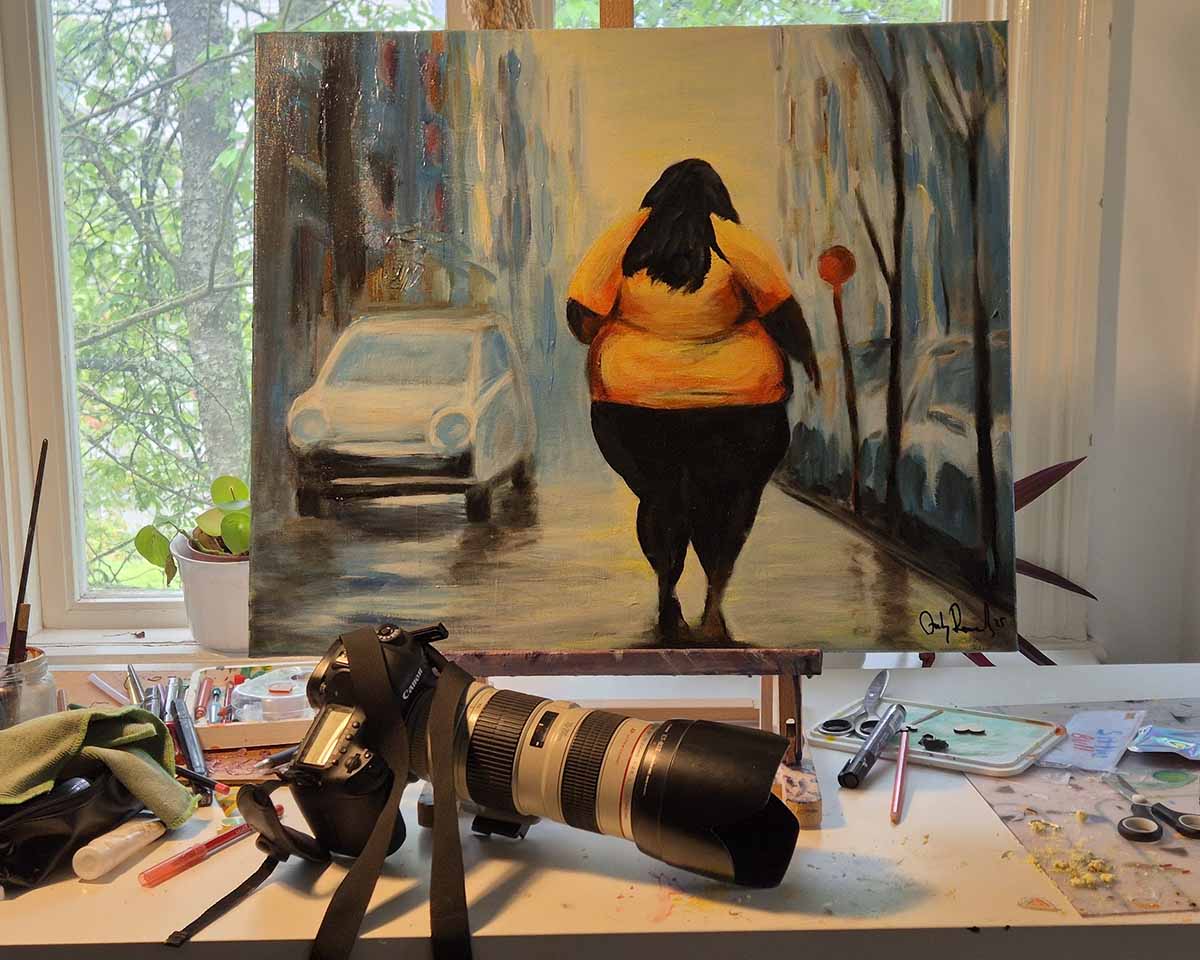
Some photographs never make it onto a memory card.
Yet they stay with us for years.
This is the story of a rainy afternoon in Arizona, a stranger who stepped into my frame, and a painting that began with a photograph that was never actually taken.
A Rainy Day in Flagstaff
Many of my most memorable photographic experiences happened far from famous landmarks.
Not in front of the Grand Canyon.
Not beneath the Golden Gate Bridge.
Not at places that appear on postcards.
Instead, they happened in ordinary places on ordinary days.
One of those days took place in Flagstaff, Arizona.
It had been raining for most of the afternoon. The streets were wet, the sky was dark and the entire city seemed wrapped in a soft, reflective light. As a photographer, those are often the moments you hope for. Rain changes everything. Colors become deeper. Reflections appear where they did not exist before. Familiar streets suddenly feel cinematic.
I remember walking through town, looking for an image that could capture that atmosphere.
Eventually I found it.
A street corner. Wet pavement. Reflections. The kind of scene that would probably go unnoticed by most people, yet somehow felt perfect.
I set up my tripod.
Attached a neutral density filter.
Composed the image.
And prepared for a long exposure.
The Woman Who Stopped the Photograph
Just as everything was ready, I heard someone shouting.
“Stop! Stop! Stop!”
At first I assumed she wanted to pass through the scene before the exposure started. That happens occasionally when people notice a camera and try to avoid walking into the frame.
But that was not her intention at all.
She ran directly toward me, laughing.
“No,” she said.
“You can’t take the picture until I’m in it.”
Then she stepped into the scene and began posing.
Completely uninvited.
Completely unexpected.
And completely wonderful.
I still remember how funny the whole situation felt. Here I was trying to create a quiet, atmospheric image of a rainy street, and suddenly a complete stranger had decided she belonged in the photograph.
And perhaps she did.
The problem was that my camera had already been prepared for a very long exposure. Several minutes, if I remember correctly.
The image I had planned no longer existed.
The image she imagined would never exist either.
By the time the exposure finished, there was little more than a vague blur where she had stood.
Technically speaking, the photograph was a failure.
The Memory That Refused to Disappear
Most failed photographs are quickly forgotten.
This one wasn’t.
Years passed.
The image itself was unusable. The file was nothing special. There was no masterpiece hidden on a hard drive waiting to be rediscovered.
Yet the memory remained.
I remembered the rain.
I remembered the reflections.
I remembered her energy and her confidence.
Most of all, I remembered the unexpected joy of that encounter.
For reasons I could never fully explain, that brief moment stayed with me far longer than many of the photographs that actually turned out well.
Perhaps that is because cameras do not always capture the most important part of an experience. Sometimes they only capture the evidence that it happened. The memory itself lives somewhere else.
From Memory to Painting
Years later, after I had returned to painting, that afternoon unexpectedly resurfaced.
Not as a photograph – As a painting.
The woman appeared first.
Then the street.
Then the atmosphere.
I was no longer interested in documenting what had happened exactly as it occurred. I wasn’t trying to recreate the missing photograph. In fact, I couldn’t have done so even if I wanted to.
Too much time had passed.
Too many details had faded.
What remained was not documentation. It was memory. And memory is rarely concerned with accuracy.
Memory edits.
Memory exaggerates.
Memory simplifies.
Memory transforms, and painting allowed me to embrace that transformation in a way photography never could.
Queen of the Street
The painting eventually became Queen of the Street.
Looking at it today, I sometimes smile at the irony.
The photograph failed.
The painting succeeded.
The camera recorded almost nothing of value that day, yet the experience itself survived long enough to find another path into the world.
What began as a missed photograph became a painting years later.
In a strange way, it feels as though the image was simply waiting for the right medium.
Not every photograph needs to become a photograph.
What Photography and Painting Have in Common
People often ask whether I consider myself a photographer or a painter. The truth is that I don’t see a sharp line between the two.
Photography taught me how to observe.
Painting taught me how to interpret.
Photography helped me notice moments.
Painting helps me understand why those moments matter.
Both begin with curiosity.
Both begin with paying attention. And both, at their best, help us preserve something that would otherwise disappear.
Not necessarily a place.
Not necessarily a person.
But a feeling.
The Photograph That Never Existed
Looking back, I am grateful that the photograph failed.
Had everything gone according to plan, I might have ended up with a technically successful image that eventually disappeared into an archive with thousands of others.
Instead, I received something much more valuable.
A story.
A memory.
And eventually a painting.
The woman in Flagstaff probably has no idea that she became part of an artwork years later. She almost certainly doesn’t remember me.
But I remember her.
And that rainy afternoon continues to exist, not because a camera captured it, but because memory carried it forward.
The photograph never existed.
The painting does.
Part 3 of 3: The Photograph That Never Existed
This article concludes a series of reflections on photography, creativity and the journey that eventually led me back to oil painting.
Part 1: Why I Returned to Oil Painting in the Age of AI
Part 2: From Photography to Oil Painting
Part 3: The Photograph That Never Existed